
A few weeks ago, I joined control room leaders from across the UK water sector at the Water Control Room Forum, “Connecting the Control Room”, hosted by Microsoft. It was also a chance for Welsh Water and FOIL to share an update on our award-winning operational response platform, ORAI. Thank you to everyone who shared their experience so openly, in the sessions and over lunch.
Two themes ran through almost every conversation: how much water companies can achieve together, and how much they have in common with control rooms in different industries.
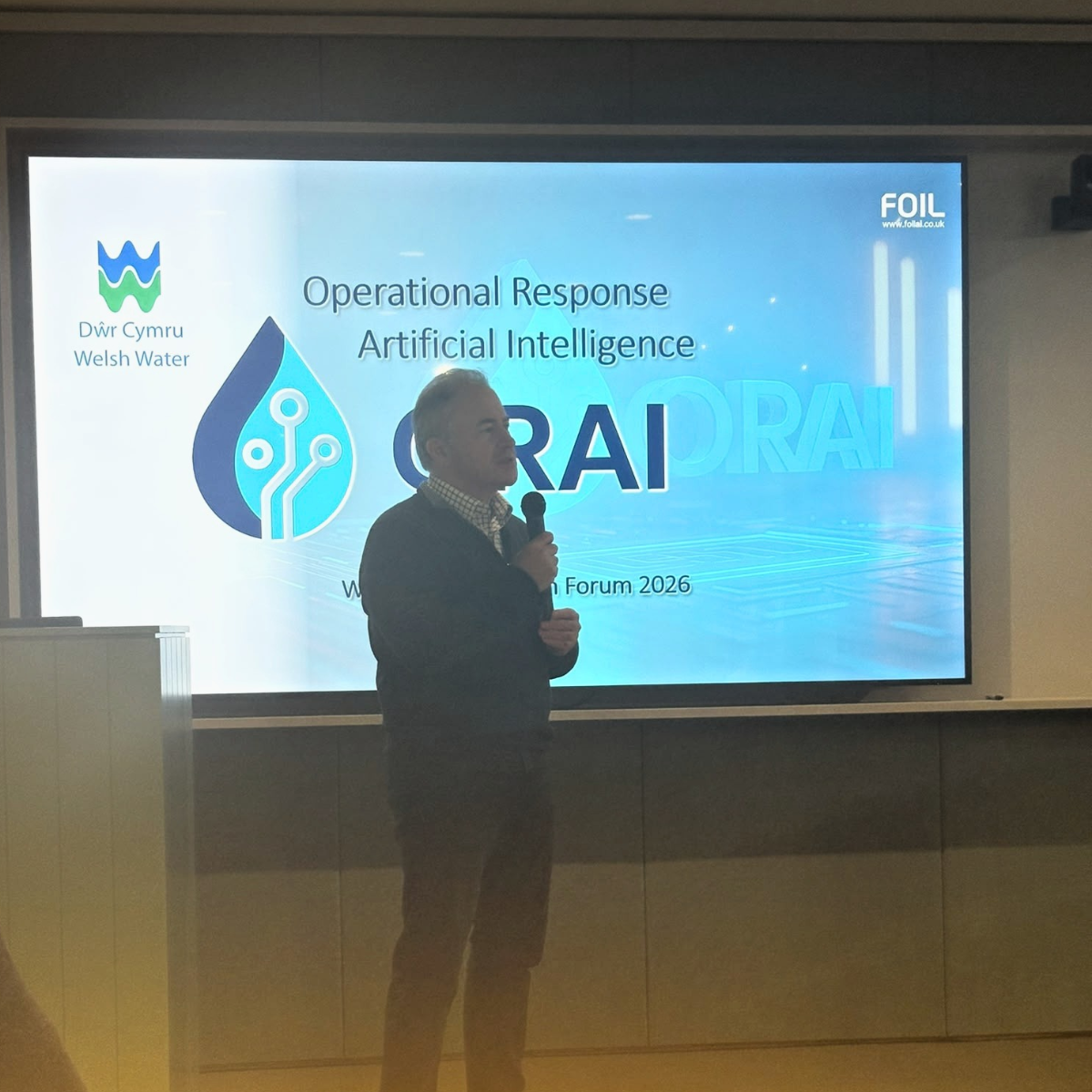
Simon Turner showcasing the ORAI platform FOIL built for Welsh Water at the Water Control Room Forum, 11 November 2026.
Cooperation, not competition
Water companies all face roughly the same problems. They maintain ageing networks, respond to pressure alarms and bursts, and balance supply against demand. Crucially, they are not really in competition. Each serves its own region, so the sector can openly share projects, mistakes and lessons learned. It was great to see such friendly cooperation, and Microsoft did a great job of bringing everyone together.
It is also how we have worked at Welsh Water, where Microsoft’s platforms, and Fabric Real-Time Intelligence in particular, have let us move at a speed that would not have been possible a few years ago.
Lessons beyond the water industry
The second theme was that water is not alone. Sessions from the Australian Energy Market Operator on its GridIQ platform, and from NESO in a fireside chat on the future of control, showed striking similarities with water. Airport control towers and police response centres work in much the same way. Every control room responds to signals, manages incidents and directs resources, so lessons, and increasingly technology, can travel between them.
That includes the hard lessons. Two days after the forum, a communications failure across US air traffic control halted departures nationwide for more than four hours, affecting around 1.5 million passengers. Officials pointed to ageing infrastructure. It is a familiar story in any control room: there is never a good time to switch everything off and modernise, so the upgrade keeps getting put off. Water knows that story only too well, and AI should not become the next thing it underinvests in.
Data quality came up again and again
If one problem came up in almost every conversation, it was data quality. Years of underinvestment have left the industry with a patchwork of siloed systems. Each handles data differently, and the same asset or alarm can be described in different ways in different places. That makes a joined-up picture of what is happening very hard to build, and it is why the unglamorous work on data foundations matters so much.
Microsoft made a point I agree with: you do not need all your data on one platform, but you do need a consistent view of it. Multiple data sources are manageable, conflicting versions of the truth are not.
The write-up nobody has time to do
Some of the most interesting conversations were about where AI can create value in ways we simply could not before. Take incident reports for example, nobody has time to write them. The problem has been fixed, and now you have to spend the next couple of hours writing it up, with pictures.
If you have the core information, the source of each signal, the actions taken and the outcome, AI can write that report for you. More importantly, while it builds a document for people to read, it can also pull out the details that enrich a knowledge graph. Which area was affected? Which type of asset failed? What evidence was there beforehand? What fixed it?
The next time a particular pump fails, the history is there. It is not in somebody’s head, and you do not have to hope the right person is on shift. If a tanker could not reach a hydrant last time, the system can tell you before you send one, and suggest an alternative. Anglian Water’s Safe Smart Systems architecture, which includes a water domain-level ontology, points in the same direction.
From reacting to anticipating
The next step is to move closer to the original signals and spot trouble before it happens. Northumbrian Water and Softwire shared their Smart Alarm Management project, funded through Ofwat’s Water Breakthrough Challenge and shaped with partners across the sector. It applies machine learning to group, prioritise and filter alarms, and the earlier you can predict a failure, the easier it is to fix.
Our ORAI update showed what this can look like in practice. During this summer’s sustained hot weather, pressure alarms rose to more than 3,000 a day. ORAI was redeployed in Welsh Water’s control room and triaged and suppressed 70 per cent of those alarms, without losing sight of what had been handled. That freed the team to focus on the 30 per cent that genuinely needed them.
Our next step is to combine models like these with the anomaly detection already in ORAI, so the network becomes more predictable and the load on the people in the room gets lighter.
Confidence has to be evidenced
Where decisions affect public health and the environment, trust matters enormously. As I wrote after the Microsoft Frontier Tour, the better word to start with is confidence, and in a control room it has to rest on evidence.
Take rezoning as an example. After a burst, operators can often send water around the network a different way to restore supply, but changing the direction of flow can stir up sediment and cause water quality problems. An AI recommendation to rezone, with a confidence score, is a good start, but the operator also needs to know what the pipe is made of, when it was last flushed, and when the flow last changed direction. With that detail, confidence goes up for both the person and the system. That is the difference between evidence and an agent saying, “Trust me, I know what I am doing.”
Confidence then builds over time. If the system is right, again and again, operators will need less evidence before acting. When a recommendation is wrong for a particular situation, trust will take a knock. That is why transparency matters so much. If people can see why a decision was made, they can judge whether it was an edge case or a systemic problem.
Lee Bryce of United Utilities, presenting for ICCRA, the International Critical Control Rooms Alliance, put it well: the most dangerous AI error is the one that “looks right enough that nobody questions it”. Human oversight has to be active, not ceremonial.
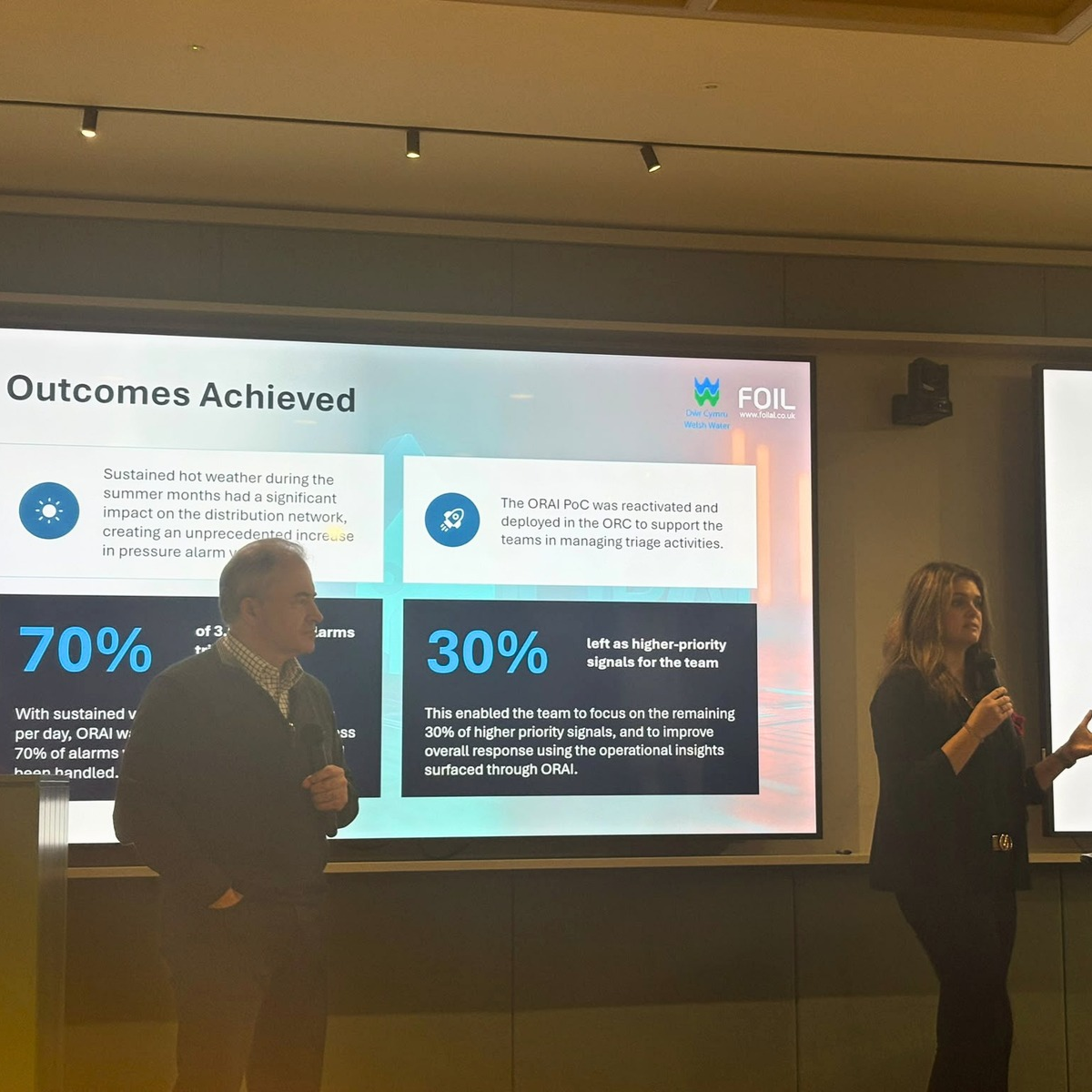
Simon Turner and Catherine Holbourn from Welsh Water demonstrating the impact of ORAI at the Water Control Room Forum.
Regulation should be a lens, not a stick
Our next phase with Welsh Water will extend ORAI to event duration monitoring in wastewater, which is, in effect, the monitoring of spills. Reporting accurate numbers is far harder than most people realise. False alarms should not be reported, yet what the public needs to know about water quality in rivers and bathing areas can never be compromised. Clear data, knowledge graphs and AI can all help get that right.
There is a bigger opportunity too. At the moment, regulation is largely used as a stick. Regulators ask for the metrics they believe are available, and fines follow when they are missed. A faster, more transparent picture of how a network is really performing could change that conversation, moving the sector from counting and penalties towards investing proactively in a more resilient network.
The autonomic water company
At FOIL, we talk about the autonomic business. The idea borrows from the body’s autonomic nervous system, which keeps us breathing without us having to think about it. An autonomic business works in a similar way: it senses conditions in real time, makes decisions within guardrails, adapts based on feedback and improves through learning. Intelligence is not a tool that people consult. It is built into how the organisation runs. We explore the idea in more depth in The Autonomic Business: A different way of operating.
For a water company, it looks like what Welsh Water is starting to see: a company that is able to manage it’s time effectively. The autonomic layer takes away the headache of trawling through hundreds of systems and signals, around the clock. It schedules work, people and resources more effectively, builds a richer knowledge platform as it goes, and suggests the next best action, with the reasoning behind it.
We will always need human expertise and judgement, and people to go out, dig holes and mend the physical network. As Chris Catchpole, Welsh Water’s Chief Data and AI Officer, says in Microsoft’s case study on ORAI, “It is important to have the human in the loop at the right stages.” The point is to reduce the cognitive load, so people can think creatively about tomorrow’s problems instead of constantly playing catch-up.
One action for the next 90 days
Start capturing what your control room already knows. Pick one type of incident and make sure every response to it is written up, with AI doing the heavy lifting, in a way that feeds structured knowledge back into your systems:
Where did it happen? The area and the asset involved.
What was seen first? The signals and evidence before the failure.
What was done? The actions taken, including what did not work.
What fixed it? The outcome, and how long it took.
Do that consistently, and within months you have the start of a knowledge estate that does not walk out of the door at the end of a shift.
My takeaways
My biggest takeaway is the cooperation. The water sector is willing to share experiences, approaches and even technology, and long may it continue.
The problems in our water network will not be solved by technology alone. But if the sector keeps working together, and keeps people at the centre, an autonomic approach can give control rooms something they have never had enough of: time.
We will be going inside ORAI in more depth over the coming months. If you are working through the same challenges in your control room, get in touch or connect with me on LinkedIn.
Simon