
Traditional data and AI strategy is dead. But what replaces it?
At FOIL, we call it the Sunday Times effect. A CEO reads an article over the weekend, comes into the office on Monday morning, and asks:
"What are we doing about AI?"
This starts a chain reaction. Budget appears. A CIO or CTO is handed the brief: build us an AI strategy. And, more often than not, they produce a perfectly good one.
It covers the technology stack, the vendor landscape, the use cases, the proof-of-concept pipeline and the data platform requirements. It's thorough. It's well researched. It comes with a sensible roadmap.
But it often starts from an assumption that the prevailing business strategy is still sound – and that's the problem.
A business strategy in flux
Most business strategies were written in a world where certain assertions held: that your competitive advantage came from scale, or distribution, or information asymmetry, or the difficulty of replicating your operations.
But when customers can access expertise through increasingly sophisticated large language models, and AI agents execute work rather than simply assist, advantages that were once solid start to look shaky.
The question is no longer how AI fits into your strategy. It's whether parts of your strategy were built on assumptions that no longer hold.
Recently, I was in a board discussion with an insurance broker when someone asked a simple question:
"If a digital assistant eventually knows everything about me, why would I need a broker at all?"
The conversation had moved well beyond automating for productivity. The board wasn't discussing which AI tools to deploy. It was questioning whether customers would still need the company 10 years from now.
This was the right conversation to have at the right time. Yet most companies treat AI strategy and business strategy as separate exercises. The AI strategy isn't shaped by the business strategy, and the business strategy hasn't been pressure-tested against what AI now makes possible.
The result is two failures happening at once. The AI programme builds capabilities the business doesn't really need. Meanwhile, the business strategy continues to defend positions that AI is already eroding.
I've seen both paths enough times to know that neither ends well.
The questions to ask
Most AI strategies answer a specific question: What technology should we buy and deploy?
That's a legitimate question. But there are actually two others that should shape everything that follows.
The first: What does AI do to your competitive position and revenue model?
Not simply how AI can make you more efficient, but how does it fundamentally change where you sit in your market? How you create value? What your customers need from you?
That's a business strategy conversation. It belongs in a boardroom, not a technology architecture review.
The second question: What does our organisation need to become?
It's not “what tools do our people need”, but “what roles change”? What decisions move? What does the operating model look like when AI is doing the execution and humans are doing the orchestration?
This is an operating model conversation. It belongs with the CEO and COO, not buried in an IT transformation roadmap.
When these two questions go unasked, you end up with an AI strategy that's technically sound but strategically hollow. It tells you what to build but not why you're building it.
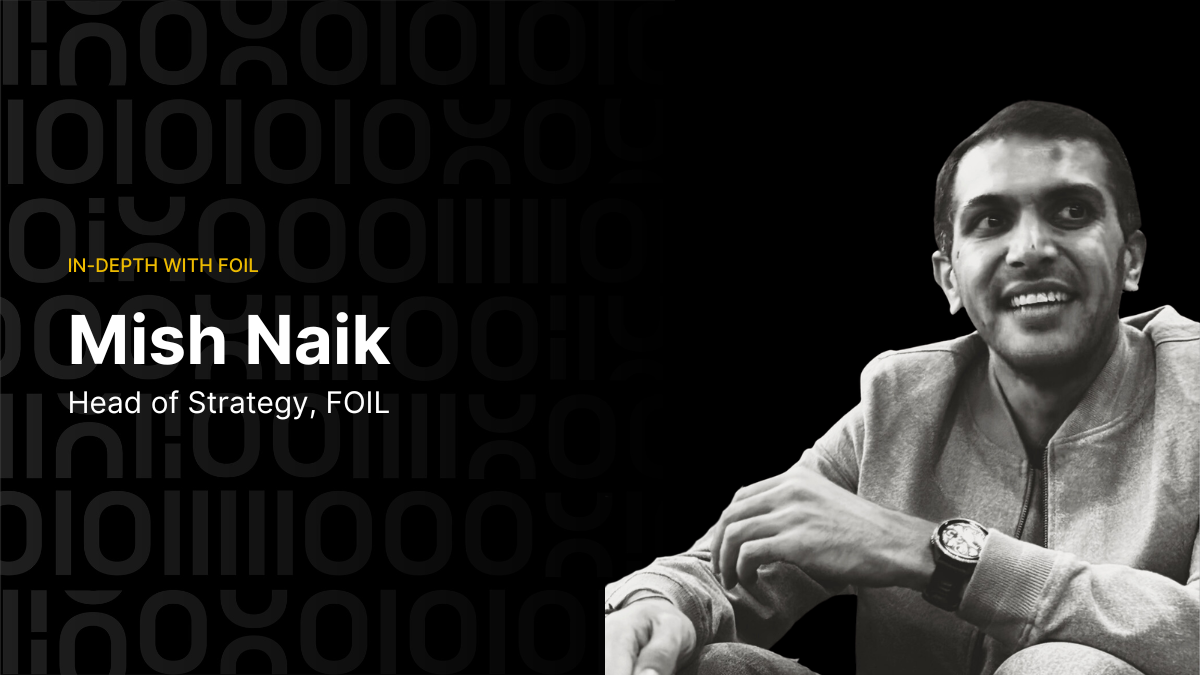
In-depth with FOIL - Mish Naik, Head of Strategy
The three missing layers
Let's say you fix the strategic foundation. You've asked the hard questions about competitive position and revenue model. You've used your AI strategy as a lens to challenge assumptions in the business strategy. You've got genuine alignment between where the organisation is heading and what you're asking AI to do.
You're still not ready. Because most programmes skip the three following layers that sit between "strategy" and "working differently on a Monday morning":
Operating model design
The opportunity isn't just automation, it comes from re-thinking how the outcome a process is delivered is done. Doing that well requires us to reimagine how we work - a shift in our current ways of working and operating model.
I've watched organisations deploy sophisticated AI capabilities and then wonder why nothing changed. The answer was almost always the same: nobody redesigned the work. The AI was producing outputs that nobody's role was designed to consume and action, in a process nobody had restructured to accommodate them.
We avoided this exact trap for a client who required a digital version of the company's operating model. We identified nine capabilities across the business where the CIO could introduce AI where it made sense. For each proposed digital solution, we also mapped how it would work alongside the existing workforce. The result? The business now has a multi-year roadmap using FOIL’s expertise to achieve its own digital transformation.
2. Workforce transition
This is the one that makes people uncomfortable, so let me be clear about what I'm not saying. I'm not saying AI replaces everyone. I'm saying it changes what people do.
Some of the questions I’m increasingly urging clients to explore is which roles change fundamentally? Which roles disappear? What new capabilities need to exist that don't today? What does the transition look like for the people affected?
In some cases, the shift could be from people managing people to people managing AI agents that are doing the majority of the execution. That changes the skills you need, likely breaking down silos or ways of structuring work we've had for years.
These aren't questions for HR to deal with after the technology is live. They're strategic discussions that should shape what you build and how you build it.
The shift from doing to managing is not a training problem. It's an identity and operating model problem. You can't retrain an execution-oriented workforce into orchestrators by updating a competency framework and booking some workshops.
3. Adoption architecture
The third missing layer is the most practical, yet it's also the most overlooked. You've built the technology. You've redesigned the operating model. You've planned the workforce transition. Now, how do you get 500 people to actually work differently on a Monday morning?
This isn't change management in the traditional sense: a communications plan and some town halls. It's designing the specific mechanisms that make new ways of working the path of least resistance. It's understanding where resistance will come from – not because people are difficult, but because the old way of working is embedded in habits, incentives and informal power structures that a strategy document just doesn't touch.
Nobody gets promoted for designing adoption architecture. But in over 10 years as a business and technology consultant, it's where I've seen more programmes fail than at any other point.
The overall diagnostic
Here's a simple test. Take your AI strategy and remove every reference to technology, vendors and platforms. What's left? If the answer is "not much", you don't have an AI strategy; you have a technology strategy with "AI" in the title.
Here's a second test. Does your AI strategy have a section on how your organisational structure changes? Not a vague reference to "change management" or "upskilling", but a specific description of which parts of the organisation operate differently, who makes different decisions, and what new roles or capabilities need to exist.
If it doesn't, it's not a strategy. It's a shopping list.
The organisations I see get this right – and there aren't many – share a few characteristics. They treat AI strategy as a business strategy exercise that happened to involve technology, not the other way around. They asked "what does our business need to become?" before they asked, "what should we build?" They designed the operating model change alongside the technology, not after it. And they were honest, genuinely honest, about the workforce implications.
None of them found it easy. The strategic questions are uncomfortable. The operating model work is slow and political. The workforce conversations are harder still. But they did the work, and the AI projects that followed were connected to something real.
The awkward truth is that most organisations would rather skip to the technology. Technology is tangible. You can put it in a roadmap and measure it. You can present it to a board in a way that feels like progress. And it sidesteps a harder problem: the AI programme builds capabilities the business doesn't really need not because the technology is wrong, but because nobody aligned the leadership team on what the business actually needed it to do.
The strategic and organisational work is messier, slower and harder to capture on a slide. But it's the difference between an AI programme that changes how your business operates and one that just changes what software it runs.
Mish Naik is a strategy practitioner at FOIL, where the focus is on making AI work in the real world, not just in the pitch deck.