
Last week, Bradley Malloy and I spent the day at the Microsoft Frontier Tour in London. The venue was packed, which says a great deal about the appetite for AI right now. Thank you to everyone who shared their views, and to those who stopped for a chat between sessions.
Before the event, we asked three questions:
How do we move AI out of pilot purgatory and into how the business runs?
How do we show value the CFO will sign off?
How do we scale without swapping one dependency for another?
The day gave us plenty to think about on all three. But one word came up in almost every session we attended: trust. It is the right conversation to have, but I think we need to be far more careful with that word than we currently are.
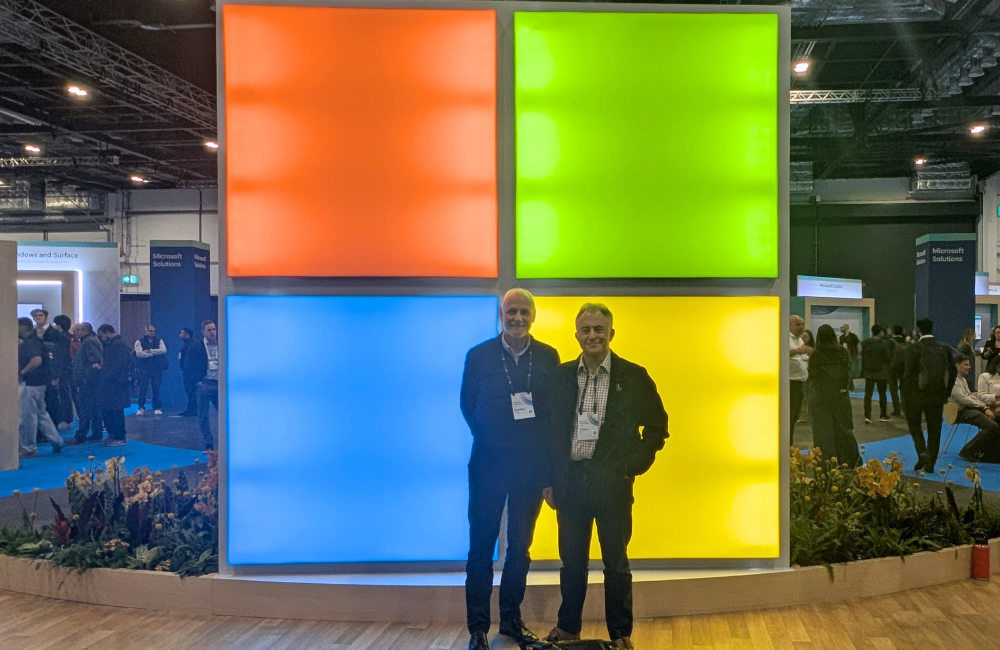
Simon Turner and Bradley Malloy at the Microsoft Frontier Tour, London, 21 October 2026.
Past the hype
One of the highlights of the day was the keynote, “Building UK’s AI Frontier”, led by Satya Nadella, Chairman and Darren Hardman, CEO of Microsoft. What struck me most was how much the message has matured. For the last couple of years, we have lived with confused messaging, from “AI will wipe out the human race” to “AI will do my job while I relax all day.” I do not believe either, and neither does Microsoft. Instead, there was a pragmatic conversation about what AI means for an organisation and how it will need to transform.
We are still in the formative stages of generative AI. Humans had to learn to write before they could communicate across time and distance and store knowledge. In the same way, we are now learning how to use AI to create real benefit. Part of the challenge is speed. The technology moves so fast that many organisations have not yet worked out what they want it to do, or why.
Personal productivity is a stage, not the destination
There was still a strong focus on personal productivity, and there is real benefit in it. If AI makes people’s jobs easier and less stressful, brilliant.
My nervousness is that it never stops there. Give people time back, and we tend to fill it with more work, moving the pressure rather than reducing it. The benefit only comes if that time goes into thinking, creativity and better decisions.
And if every organisation uses the same tools for personal productivity in the same way, we end up with the same competitive landscape we have today, just reached a little faster. Personal productivity is a necessary learning stage. The return on investment will come from the next one.
Leveller or accelerator?
Context, as well as Trust, also underpinned almost every session. Satya described a “reverse information paradox”: every time you use a learning system, you risk leaking value into it. Organisations must capture and keep the knowledge they create, rather than leak it into someone else’s system. This is coupled with the question “how do you constantly build on the knowledge you create”
An LLM knows a great deal about the world, and about cat videos, but nothing about your organisation. Without your context, it gives you roughly the same answer as your competitors. AI then becomes a leveller, not an accelerator. To be uniquely valuable, it needs to understand your business, your challenges and the mechanics of how you operate, described honestly and kept current. Getting that structure right means knowledge graphs, taxonomies and, we strongly believe, ontologies.
Separate the harness from the model
Satya’s acid test for any agentic system was simple: can you remove any model and still improve against your own evaluations? If you cannot, you have swapped one dependency for another. Your memory, context and the actions your agents can take should sit outside the model, so that you can change models as the market moves. That answers our third question directly. The architecture, not the model, is the long-term asset.
Right-sizing the intelligence
One announcement deserves a closer look. Satya introduced Microsoft Decision-1, which also featured in the Foundry demo. It belongs to a new class of decision models, sometimes described as non-generative AI. Rather than generating fluent text, it returns a structured answer, a calibrated probability for each of a fixed set of options, in a single pass. That makes it far faster and cheaper than a traditional large language model.
Not every step in a business process needs a model to write an essay. Is this incident urgent? Should this agent act, or hand back to a person? These are decisions, best answered quickly, consistently and at low cost. An entity running a business function makes thousands of decisions every day. Directing a decision model at those, and reserving larger models for the work that genuinely needs them, is where much of the return on investment will come from. It helps with trust too, because a repeatable structured decision is easier to test, measure and audit than free text.
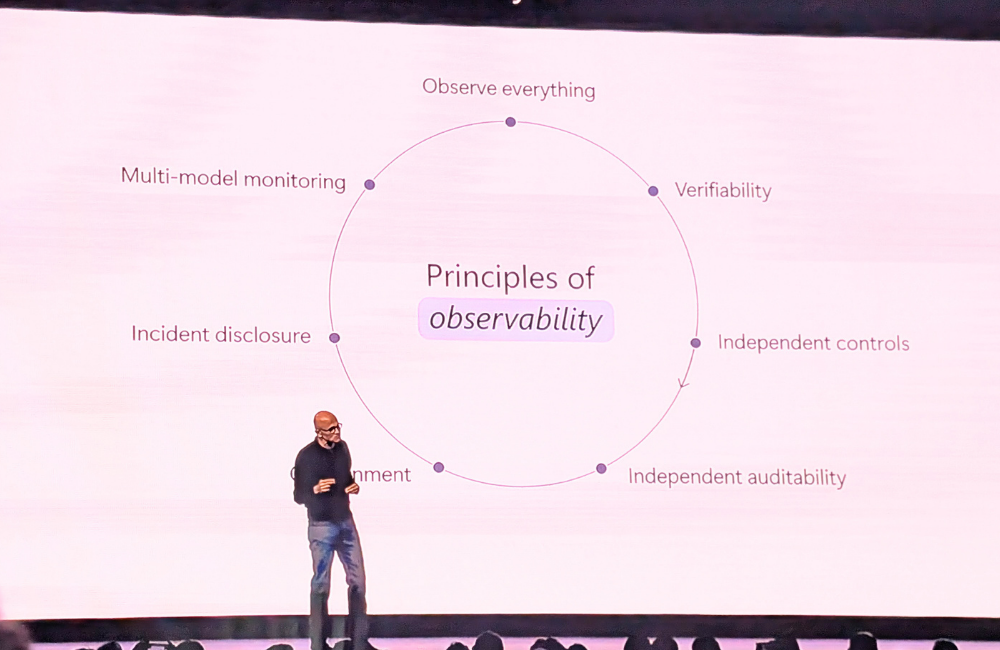
Satya Nadella sets out Microsoft’s principles of observability for AI agents at the Microsoft Frontier Tour, London.
Trust arrives on foot and leaves on horseback
Microsoft’s mantra at the moment is “intelligence plus trust”, and trust matters more than ever, particularly given the alarming rhetoric around AI. It is also more complicated than it first appears. Satya was candid that models are becoming more capable while alignment remains elusive. Microsoft’s answer is to treat agents as a form of insider risk: give every agent an identity, log every action and every step of its reasoning, set policy and monitor behaviour. It is also bringing IT, security and financial controls together into a single control plane, which goes a long way towards answering the CFO question.
That is necessary, and it is the right foundation. But observing every step an agent takes is almost mechanical. Does it build trust on its own? I do not think it does.
Compliance and regulation can be met, even if it is sometimes harder than we expect. Trust is different. As one of my favourite expressions goes, trust arrives on foot and leaves on horseback. It is built, earned and demonstrated over time, and it is innately human. We do not trust a new colleague because we can see their activity log. We trust them because they deliver, consistently, and because they tell us when something is wrong.
AI, on the other hand, does not mind in the slightest whether we trust it. So I think the better word, to begin with, is confidence: knowing when to rely on an output, and when to question it.
The most interesting idea of the day was that agents should not inherit our permissions, but earn access based on how they behave. That is much closer to how trust works between people, and central to how we think about autonomic entities at FOIL: governed units of intelligence, each scoped to a business function, driven by business goals and KPIs, with shared memory, guardrails and human oversight. Autonomy is not granted on day one. It is extended as an entity proves itself, with people staying accountable for the outcome.
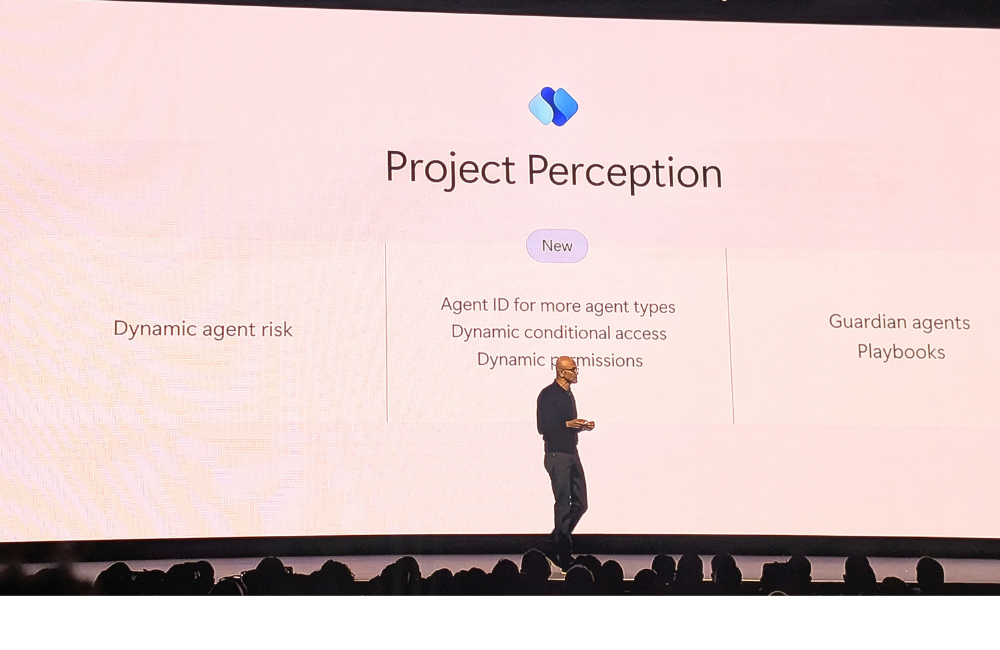
Microsoft’s Project Perception introduces dynamic permissions and agent risk, a step towards agents earning access based on behaviour.
Taking the next step
The conversations between sessions were more grounded. The question I heard most was: this all sounds brilliant, but how do we take the next step? Most people had explored Copilot, ChatGPT or Claude, and wanted to know how to reach the first rung of a ladder that leads somewhere.
Later in the keynote, Darren Hardman, CEO of Microsoft UK and Ireland, spoke about the UK’s readiness for AI. One finding was that boards and the C-suite are more ready for AI than the average UK worker. I would question that a little, because in some industries we see the opposite. In law, for example, people on the ground often use AI more than their senior leaders. In industrial settings, where knowledge is locked in people’s heads, teams know AI will change things significantly. Leaders need to close that gap, so the organisation shares one view of how to use AI.
That brings me to the Frontier Firm. The concept starts with a hard question: can your business, as it is currently structured, ever change enough to become truly AI native? For most organisations, revenue pressures and years of established process make that very difficult.
If the answer is no, one option is to step outside your current business and design an AI native one on a clean sheet of paper, where you can experiment without putting existing revenue at risk. The more practical route is to apply the same lens to one process or function at a time.
Either way, doing the same thing faster, or automating how we work today, is a start. It should not be the end goal. The real opportunity is to rethink what we do, not only how we do it, and to be disruptive in ways, and at speeds, we have not imagined before. Doing that with confidence depends on two things: owning the context that makes AI valuable, and building the trust that allows it to act.
One action for the next 90 days
If you take one thing from all this, make it this: get clear on your knowledge. In practice, that means answering four questions:
What is genuinely unique about how you operate? The knowledge and judgement that win you work.
Where does it live today? In systems, documents or people’s heads.
Who owns it? Keep it in your environment, not someone else’s system.
How will it stay current? Every project should feed back in.
None of this needs a new tool. It needs an engineered clarity about your business that most organisations have never had before.
My takeaways
Microsoft’s Frontier Firm vision is producing the platforms and tools to move beyond personal productivity towards AI that runs complete business functions, with guardrails and human oversight. That is the journey towards what we call an autonomic business.
The tools will not reimagine your organisation for you, though, and they will not build trust for you. That still takes people willing to rethink the business from the inside out. Done well, it gives us more time to be creative and, ultimately, more human. Download our Beyond AI whitepaper to explore the autonomic business in more depth.
How are you approaching trust, or confidence, in your AI estate? If you are working through the same questions, connect with me on LinkedIn. I would value comparing notes.
Simon