
Keeping hiring human: Reflections with Josie West, Chief Innovation Officer
Recently, Frazer Jones brought HR leaders and AI specialists together for its panel, Keeping hiring human in the age of AI, to tackle one of the most pressing questions in the world of work: how do organisations embrace AI without losing the human connections that make hiring, and work itself, meaningful?
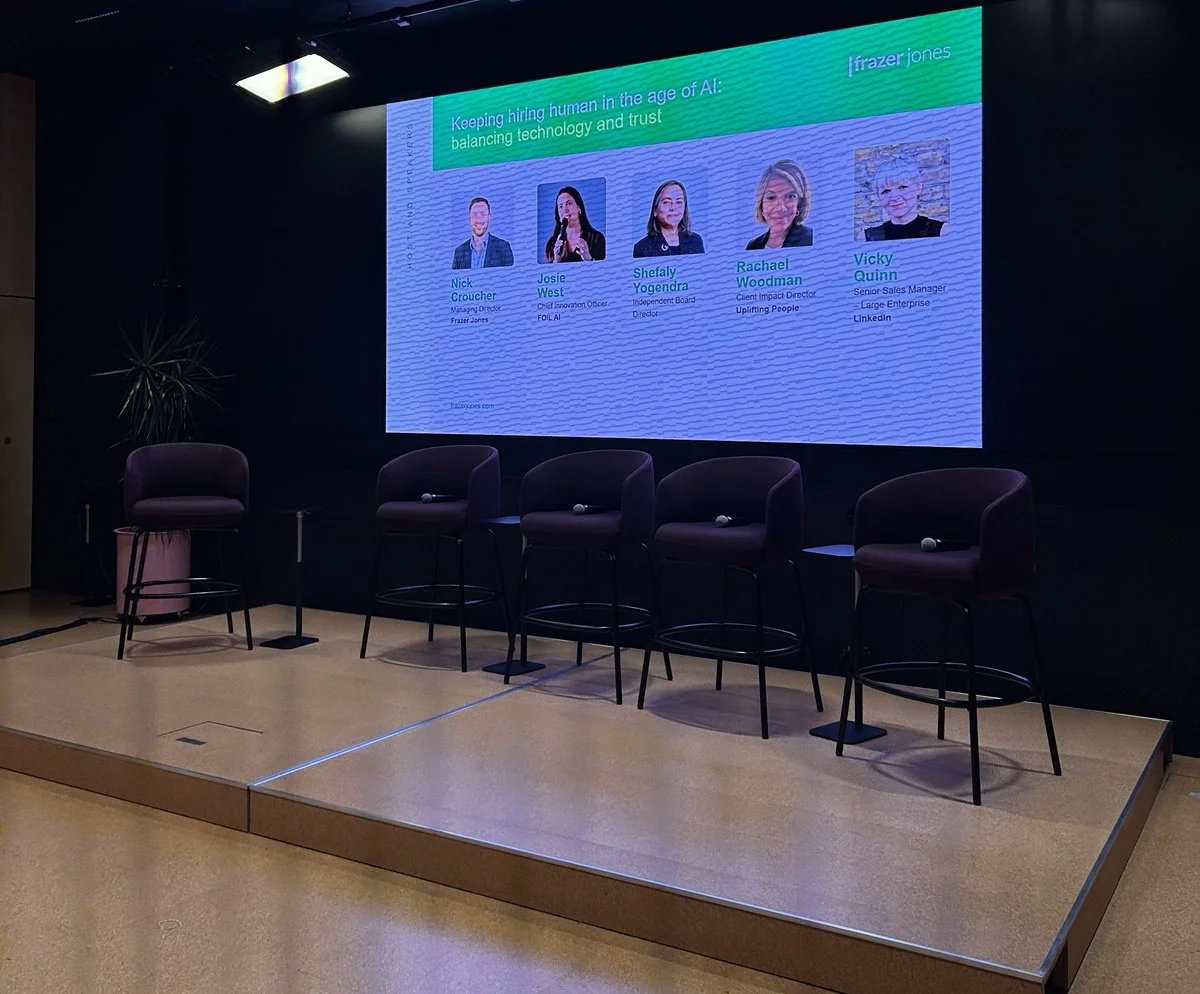
Nick Croucher, Global Managing Director of Frazer Jones, hosted a panel of Josie West, Shefaly Yogendra Ph.D., Rachael Woodman and Vicky Quinn.
Josie West, FOIL's Chief Innovation Officer, reflects on the afternoon.
Firstly, thank you to Nick and the Frazer Jones team for hosting such an open discussion. Panels can easily drift into formal and safe territory; this one felt really open, honest and with difficult topics to discuss. Here are my reflections.
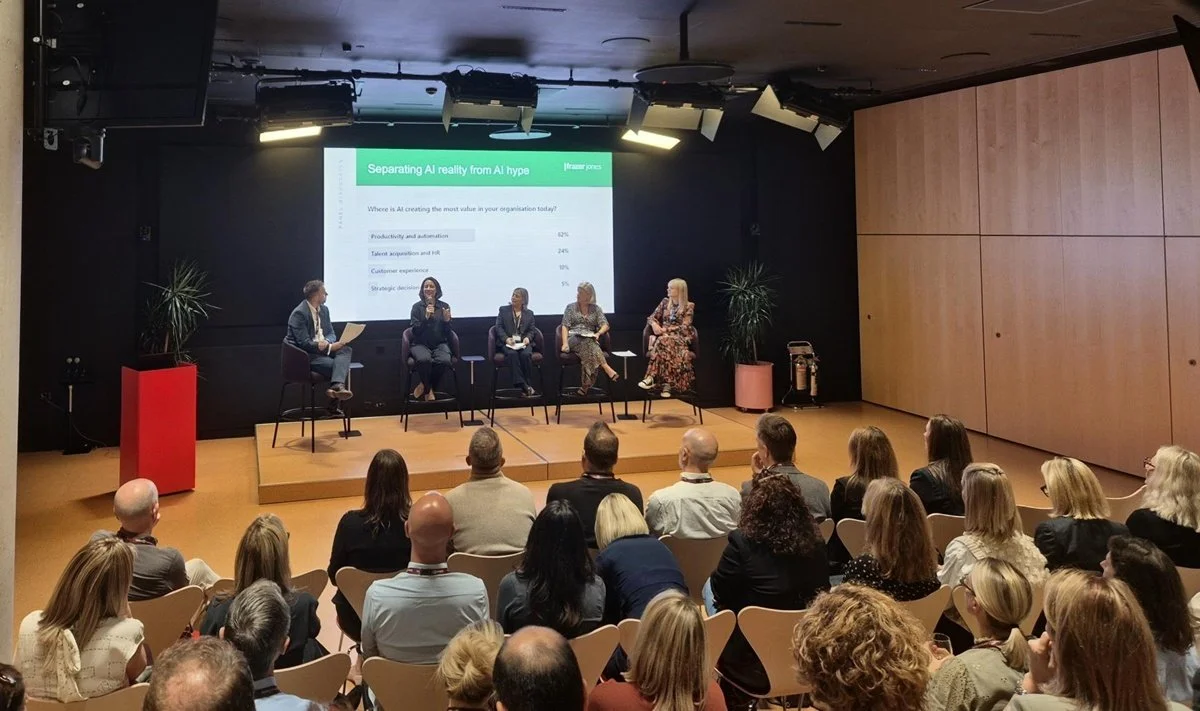
When Nick asked what excites or concerns me most about AI, I gave the same answer to both: AI can elevate the value of the human, if we do it right. With an audience of Chief People Officers, I’d say most agreed, but good AI education is required to make that happen.
The hype is not false. The focus is.
The biggest misconception I see is that leaders are still chasing the tool. Blinded by intelligent marketing and a societal pressure to “do AI”, and now, “do agents”. Tools that are focused entirely on personal productivity, which in my eyes is not the right impact and return for investment.
The hype itself is not wrong. AI has extraordinary potential in healthcare, defence and education. Yet as organisations, we have largely pointed it at doing the same things faster. Many leaders measure success through tool usage, which is not an outcome. I’m not saying there is an easy answer to this, but unless the business can measure value, the focus and measures of success are wrong.
Organisations are not yet focusing on the supporting functions and capabilities that need to change around AI capability. That is what makes the hype inaccessible. The reality on the ground has not moved as quickly as the headlines: most companies still work with poor data foundations, poor data quality and low AI literacy at leadership level. A licence agreement won’t fix that.
More noise, not more efficiency
Nick asked whether we overestimate what AI can do in the short term and underestimate what it will do in the long term. My view differs slightly. We are actually underestimating the short term and ignoring the long term entirely.
A law firm I am working with is reassessing its commercial model because AI now speeds up much of its work. However, at the same time, its clients send four pages of questions generated straight from an AI assistant, most of which they do not actually care about. Right now, AI is producing more noise, not more efficiency.
The long-term opportunity is far bigger than many are thinking today. AI gives us the chance to fundamentally change the way we work, to remove every process that no longer makes sense, and to build what an organisation knows into intellectual property rather than leaving it in people's heads. Most organisations are not doing this. They remain fixated on personal productivity.
Candidate experience cuts both ways
The audience poll during the panel suggested many in the room felt AI had damaged the candidate experience. Asked whether organisations have improved hiring efficiency at the cost of candidate experience, my answer was yes, but it is two-sided.
Candidate experience matters enormously. AI has also driven a flood of low-quality applications, many from candidates who do not really care about the role. As the panel noted, when both employer and candidate automate, volume rises and signal falls.
That changes the job. We agreed that the role of a recruitment firm, and of a recruiter within an organisation, moves away from processing volume and towards judgement: understanding the role, reading potential and making the human call. Vicky Quinn put it well on the day: the time AI saves only counts if you reinvest it in better conversations.
Transactional workplaces are already here
Are we at risk of creating more transactional workplaces? I think they are already arriving. I see business development professionals sending emails written entirely by Copilot, and it strips away their whole personality. It is shocking how quickly it’s happening and I really hope organisations put governance in place to stop this before it devalues them as a business.
The answer starts with your employee value proposition. Why do your people choose to work for you? If AI saves money, invest it in the things that strengthen that answer: strategic thinking, innovation, spaces where employee voices are heard, and diversity of thought.
Adoption is a human challenge. The most effective approach I have seen uses AI influencers inside the organisation, people who drive adoption through their own performance and by sharing openly. That strips away the vulnerability many people feel about admitting they do not yet know how to use these tools.
Which moments in the employee lifecycle should always stay human? My honest answer is that it depends on the organisation. The moments Nick put to the panel, from interviews, offers and performance conversations to redundancy decisions and career development, each carry different weight in different cultures. What matters is that leaders decide deliberately, rather than letting automation decide for them. A few years ago, I worked with a CEO of a high fashion brand, who vowed to put a ‘no AI halo’ on her design process. AI was available to speed this up, but she knew human led design was what her customers paid for, why would she sacrifice that for speed.
Is AI the new ESG?
The investor question was one of my favourites. Is AI becoming something every board says it has, but few can explain how it creates value?
I see two layers of AI. The first is AI for personal productivity, through tools such as Copilot. Useful, but not strategic. The second is AI for client value, disruption, and reshaping operating models and processes, that layer is strategic.
Most of our largest clients sit within investment cycles, with few of them fixated on productivity. A credible AI strategy addresses the existential threats and opportunities facing an organisation: how it responds on pricing, on operating model, on the capture and use of data and knowledge, and on skills. If a strategy leads with a Copilot rollout, it is a technology and product strategy, not an AI strategy. Shefaly Yogendra put it more bluntly still: there is no such thing as an AI strategy, only business strategy.
One action for the next six months
Our final question asked for one action every HR or business leader should take in the next six months. Mine was simple: separate your AI ambitions.
Separate AI for personal productivity from AI for organisational change. They need different owners, different measures and different levels of investment. HR leaders in particular should form an opinion now on the blended human and agent workforce, the operating model it needs, and the skills development that will sustain it. Then focus on the big bets, not the long tail of small wins.
My takeaways
We all agreed that technology will keep advancing. That is the one certainty. What the afternoon confirmed for me is that the winners will be the organisations with the ambition and the appetite to actually move forward, and the discipline to point AI at the right problems.
It also reinforced something we believe deeply at FOIL. AI should embed intelligence into how a business operates, not bolt productivity tools onto the side.
Done well, that frees people for the human skills the panel agreed matter more than ever: judgement, empathy, relationships and leadership. The organisations that keep the human touch, in the right places, will win.
Josie